SASANA WIRATAMA
Address: Jl HOS Cokroaminoto TR III/430, Yogyakarta
55244, Indonesia
GPS Coordinate: S7°47'12.7" E110°21'5"
Of aristocratic class,
direct descendant of the Yogyakarta King, but he prefers to live humbly
with lay people. Pangeran Diponegoro is one of the strugglers to whom
the Dutch colony is afraid.
SASANA WIRATAMA - Commemorating the Struggle of Prince
Diponegoro
20 July 1825
The Castle in Tegal Rejo where Pangeran
Diponegoro lived
Outside the fort there were three-time gun explosions; the war
started. North, east and south sides were besieged by Dutch troop.
Paramilitary troop at the west side fought hard. Lead by Joyomustopo and
Joyoprawiro, the paramilitary troop was pushed back. The force was far
different. A man in white robe and white turban on his head calmly and
wisely chose to break down the west wall of the castle. With several
hits the wall was broken down. A command was given to save the family
and the remaining paramilitary troop. With his entire troop, the man in
white robe chose to go away to the west. It was such a difficult
decision made to save his family and troop.
Kanjeng Pangeran Diponegoro (Prince Diponegoro)
He was born in the Kingdom of Yogyakarta on 11 November
1785; his nickname was Bendoro Raden Mas Ontowiryo and later was called
Kanjeng Pangeran Diponegoro as the oldest son of Raden Ayu Mangkorowati
(the daughter of Pacitan Regent) the concubine of Sri Sultan Hamengku
Buwono III (HB III).
Pangeran Diponegoro had stronger interest in religious life and
equality with lay people, so that he preferred to live in Tegalrejo
village.
Java War
During the reign of HB V (1822), Pangeran Diponegoro
did not agree to the governance system held by Patih Danurejo and a
Dutch officer. This rebellion culminated in 1825, after the Dutch made
the road connecting Yogyakarta and Magelang passing through his house
(now a railway). The Dutch colony that did not ask Pangeran Diponegoro
for permission was fought by Pangeran and his troop. The Dutch that had a
reason to seize Pangeran Diponegoro as a rebel; the Dutch troop
surrounded his house on 20 July 1825. Being shoved, Pangeran and his
family saved their lives to the west until Dekso village in Kulonprogo
Regency and continued to the south reaching Selarong cave located five
kilometers west of Bantul town.
The Dutch troop that did not succeed in capturing him fired
Pangeran Diponegoro's house.
Selarong cave that is situated in Kentolan Lor village, Guwosari
Pajangan of Bantul Regenc was the camp of Pangeran Diponegoro where he
set guerrilla strategy against the Dutch colony. Pangeran lived in the
west part of the cave, named Goa Kakung, functioning as his place for
meditating. Raden Ayu Retnaningsih (his concubine who faithfully
accompanied him after the demise of his earlier two wives) and his troop
lived in Goa Putri in the eastern part.
The Diponegoro War that lasted until 1830 was called
Java
Oorlog (Java War) in history books written by the Dutch writers. In
this war, the Dutch colony lost not less than 15,000 soldiers and spent
more than 20 millions Gulden.
The History of Sasana Wiratama building
Located about 4 kilometers of Jogja city center, as
wide as 2.5 hectares land that used to be managed by Tourism and Culture
Department was handed by the heir of Pangeran Diponegoro, Raden Ayu
Kanjangteng Diponegoro, to function as a monument after signing a
transfer letter with Nyi Hadjar Dewantara and Kanjeng Raden Tumenggung
Purejodiningrat. On the land that is now owned by Yogyakarta Kingdom,
beginning from mid of 1968 until 19 August 1969, a monument was built on
pringgitan building that adjoined with the pendopo at the center of the
complex. The project was initiated by Major General Surono who was the
Commander of the Military District and was inaugurated by President
Suharto. This place was then named Sasana Wiratama that means the place
for soldiers.
Passing through the main gate, turning to west side, the hall is surrounded by museum, the broken wall, dormitory and library. Additional buildings other than the hall including the gate were made between 1970 and 1973, led by Major General Widodo. The broken wall and Padasan, the place for Moslems to take clean water before praying, and Komboran, a stone container for Pangeran Diponegoro's horses to get water and food, at the south-east part of the hall are inheritances of Pangeran Diponegoro.
In front of the building situated on H.O.S Cokroaminoto Street in Tegalrejo village, there is a statue of Lieutenant General Urip Soemohardjo with the writing "Orde.Contre-Ordre.Desordre!" on the east side and a statue of General Sudirman with the writing "Jangan Lengah" meaning 'Don't be inattentive' on the west side. These statues represent the place where Indonesian people struggled for their independence. After passing through the gate, there is a two-meter high wall resembling the dome of a mosque with a picture of a giant opposing a dragon on the upper part of it. "The picture means Butho Mekso Basuki ning Bawono, Javanese old words or codes that are expressed in pictures," said Budiman to YogYES. The words are read backwards. The writing of 5281 means 1825 as the onset of Diponegoro war.
Historical Remains
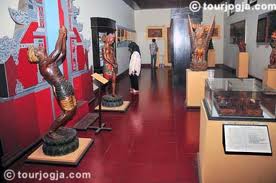
There are 100 items as the collection of Diponegoro
museum, consisting of some original goods of Diponegoro paramilitary
troop ranging from war weapons, coins, precious stone and home
furniture. Some examples of weapons are lance, kris, sword, arrow,
bandil (iron hammer), patrem (a kind of weapon for women), and candrasa
(a sharp weapon that looks like a chignon pin used by women spies).
There are also some household tools made from brass in 1700s such as
betel container and its kecohan (container in which someone spits after
chewing betel), canting (an instrument used to make batik) holder,
bringsing pot, and various forms of kacip (a tool to slice areca nut as
an ingredient to chew betel).
There are two sacred weapons kept in this museum, namely a kris with 21 curves named Kyai Omyang, made by an empu (kris maker) who lived during Majapahit time and a sword originating from Demak Kingdom. Those two sacred weapons are believed to be able to prevent disasters.
There is also a small statue of Ganesha, the lace of the horses that pull a cart presented by HB VIII, a couple of Loro Blonyo statue and a pair of decorative lamp. There are some parts of the gamelan (Javanese music instrument) owned by HB II that was made in 1752
in the forms of a percussion and wilahan bonang made of wood, copper and brass. There is also a cannon in the east of the hall.
In addition to the broken wall, padasan and komboran, other inheritances are kept in Magelang. There are Koran, Cup and Pot, Robe, four tables and one chair. In Satria Mandala museum in Jakarta there are horse saddle and a lance. One kris of Pangeran Diponegoro is still kept in Netherlands.
The Demise of a Great Struggler
After lasting for five years and suffering from big loss and
promising 50,000 Gulden to whomever that can capture Pangeran
Diponegoro, the Dutch colony still could not capture him.
- 16 February 1830, Colonel Cleerens came to Pangeran
Diponegoro in Remo Kamal, Bagelen, Purworejo to invite him for a meeting
in Magelang. Pangeran Diponegoro agreed to this idea.
- On 28 March 1830, with his troop, Pangeran Diponegoro saw
General Governor Markus de Kock. In the meeting De Kock urged Pangeran
Diponegoro to cease war. Pangeran Diponegoro refused it. The Dutch
colony, via Colonel Du Perron, had prepared a careful attack. Pangeran
Diponegoro and his troop were defeated. On the day, Pangeran Diponegoro
was exiled to Ungaran and then he was brought to Residence Building in
Semarang.
- 5 April 1830 he was sent to Batavia by Pollux ship.
- 11 April 1830 he was arrested in Stadhuis (now Fatahillah
museum).
- 30 April 1830, General Governor Van den Bosch decided to
send Pangeran Diponegoro, Retnaningsih, Tumenggung Diposono and his
wife, and other followers such as Mertoleksono, Banteng Wereng and Nyai
Sotaruno to Manado for an exile.
- 3 May 1830, Pangeran Diponegoro and the group were sent by
Pollux ship and were arrested in Amsterdam Fort. The Dutch colony still
considered him a threat since in this place he cans still communicate
with community.
- In 1834 he was exiled separately. Pangeran Diponegoro and
Retnaningsih were sent to Makassar, South Sulawesi and were arrested in
Roterdam Fort under tight control.
- Pangeran Diponegoro could not move freely. He spent the
days with Retnaningsih and finally he died on 8 January 1855. He was
buried in Kampung Melayu, Makassar, side by side with his wife tomb.
After 151 years, Indonesian people still feel the lost of the great struggler. He had the struggle spirit without ever surrendering.
Commemorating a great struggler can be done in different ways. If you want to have a closer look at the spirit of Pangeran Diponegoro's struggle and experienced it yourself, the broken wall will tell you about it silently. You can only see such an extraordinary view of the wall that was broken only by the hits of Pangeran Diponegoro's in Sasana Wiratama. (YogYES.COM: R. Syah)
Sasana Wiratama museum / Diponegoro monument
Jl. HOS Cokroaminoto TR.III/430 Tegalrejo, Yogyakarta
Phone: +62 274 622668.
Visiting hours:
Monday to Saturday: 08.00 a.m to 01.00 p.m.
Sunday: closed
Entrance Fee: voluntary